
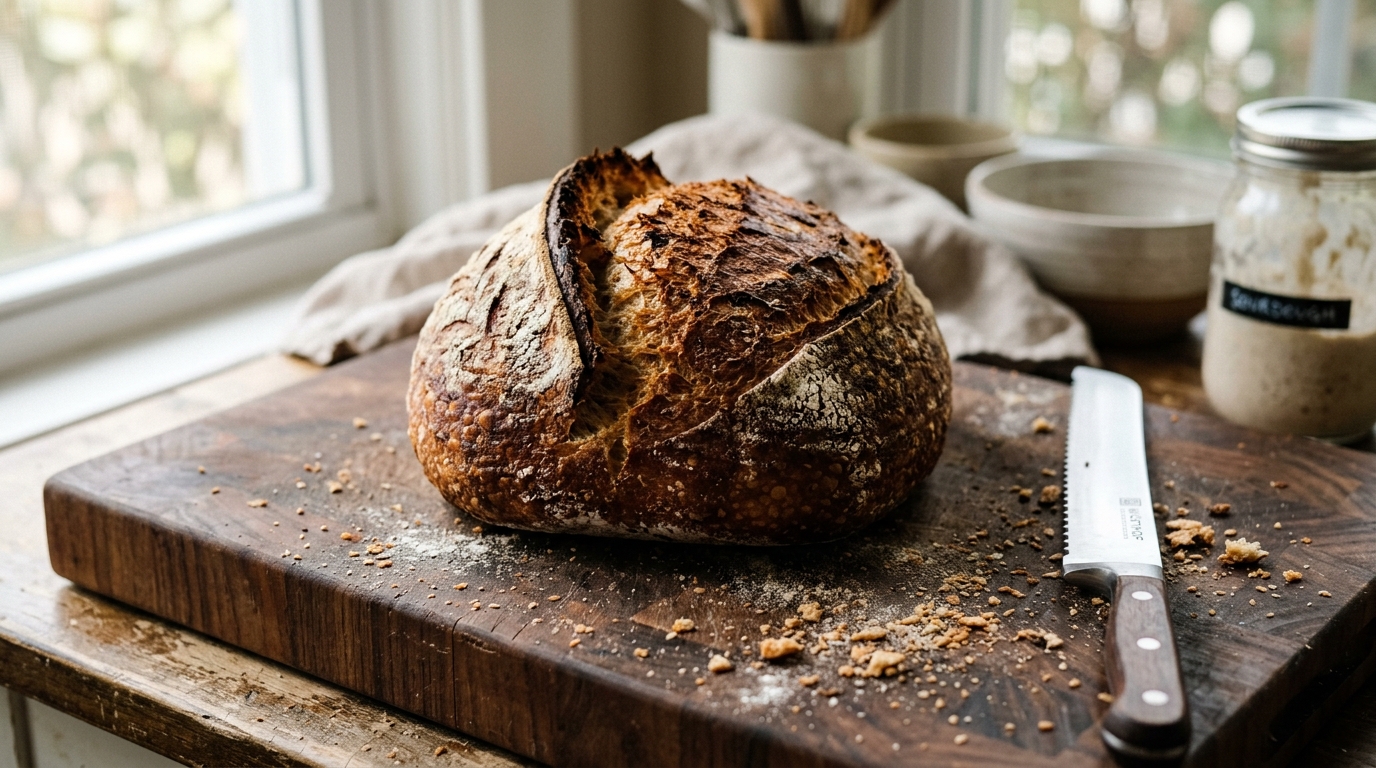
1. Diagnosing Your "Sourdough Pancake"
A flat, disc-shaped loaf is the rite of passage for every beginner sourdough baker. Fortunately, the crumb pattern of a baked loaf provides an infallible forensic record of exactly what went wrong in your process.
By learning to read the bubbles and dense areas, you can fix the issue on your very next bake day.
2. Under-Proofed vs Over-Proofed: The Crumb Test
How to distinguish between the two primary causes of flat bread:
- Under-Proofed (Fool's Crumb): You see massive caverns and huge holes at the top of the loaf, surrounded by a dense, tightly packed gummy layer of dough at the bottom. This means bulk fermentation ended far too early; yeast had not populated the dough uniformly.
- Over-Proofed (Exhausted Gluten): The crumb is uniformly dense with small, collapsed cells. The loaf spreads sideways in the oven rather than expanding upward because all food was consumed and the gluten net disintegrated.
3. Weak Starter & Inoculation Mistakes
If your starter takes 12 hours to double at room temperature, it does not possess sufficient microbial vigor to lift 500g of wet dough.
Before mixing dough, ensure your starter can double (or triple) in volume within 4 to 5 hours after a 1:1:1 feeding at 24°C (75°F). If it struggles, feed it twice daily with 50% whole rye for three days to build strength.
4. Insufficient Surface Tension During Shaping
Gluten is a balloon. If you simply roll dough into a basket without tightening its outer skin, the gas will expand sideways instead of upward during oven spring.
Master the pre-shape and bench rest: allow 20 minutes on the counter to relax, then use cupped hands and a bench knife to pull the dough toward yourself, stretching the outer skin taut without tearing it.
5. Inadequate Oven Preheating & Steam Loss
Domestic ovens cycle elements on and off. If you place dough in a Dutch oven that has only preheated for 15 minutes, the cast iron has not stored enough thermal mass to deliver the instantaneous heat blast needed for dramatic oven spring.
Always preheat your Dutch oven for a full 45 to 60 minutes at 245°C (475°F) before loading your loaf.
Fix Flat Loaves Once and For All with The Fix-It Kit
Get our complete Sourdough Fix-It Kit for forensic crumb diagnostic flowcharts, temperature calibration tables, and printable batch journals to rescue your next bake.
Get The Sourdough Fix-It Kit ($7) →Frequently Asked Questions
Why does my dough spread completely flat as soon as I tip it out of the banneton?
Dough that puddles sideways usually suffers from over-fermentation (weakened gluten bonds) or weak shaping tension. In addition, always tip cold dough directly from the fridge into the hot pot to help it hold its vertical shape.
How do I know if my flat loaf was under-fermented or over-fermented?
Examine the crumb: giant holes at the top with a dense wet bottom layer indicates under-fermentation. A flat loaf with small, uniformly dense collapsed holes indicates over-fermentation.
Does the type of flour affect how flat my sourdough turns out?
Yes. Flour with low protein content (under 11%) cannot hold the weight of water and gas bubbles. Use unbleached bread flour with at least 12.5% to 13% protein for strong vertical rise.