
1. Why Kitchen Timers Fail in Sourdough Baking
The single most common reason home bakers produce dense, flat bricks is following recipes that prescribe rigid timings like "bulk ferment for 4 hours."
Wild yeast metabolic rates double with every 5°C (9°F) increase in ambient dough temperature. A dough that takes 7 hours to properly ferment in a 20°C (68°F) autumn kitchen will over-ferment and liquefy in just 3.5 hours on a 27°C (80°F) summer afternoon. You must learn to read the dough, not the clock.
2. The Temperature vs Rise Percentage Rule
Because fermentation continues during pre-shaping and the initial hours of cold retardation in the refrigerator, your target volumetric rise at room temperature depends directly on your dough's temperature:
- Warm Dough (26°C–28°C / 78°F–82°F): End bulk fermentation at only 30% to 50% volumetric rise. Warm dough cools down slowly in the fridge and will continue fermenting for several hours before yeast goes dormant.
- Moderate Dough (23°C–25°C / 74°F–77°F): End bulk fermentation at 50% to 75% volumetric rise.
- Cool Dough (20°C–22°C / 68°F–72°F): End bulk fermentation at 75% to 100% (doubling). Cool dough chills to dormancy in the fridge almost immediately.
3. The 4 Sensory Cues of Mature Bulk Fermentation
Look for these four non-negotiable physical markers before touching your bench knife:
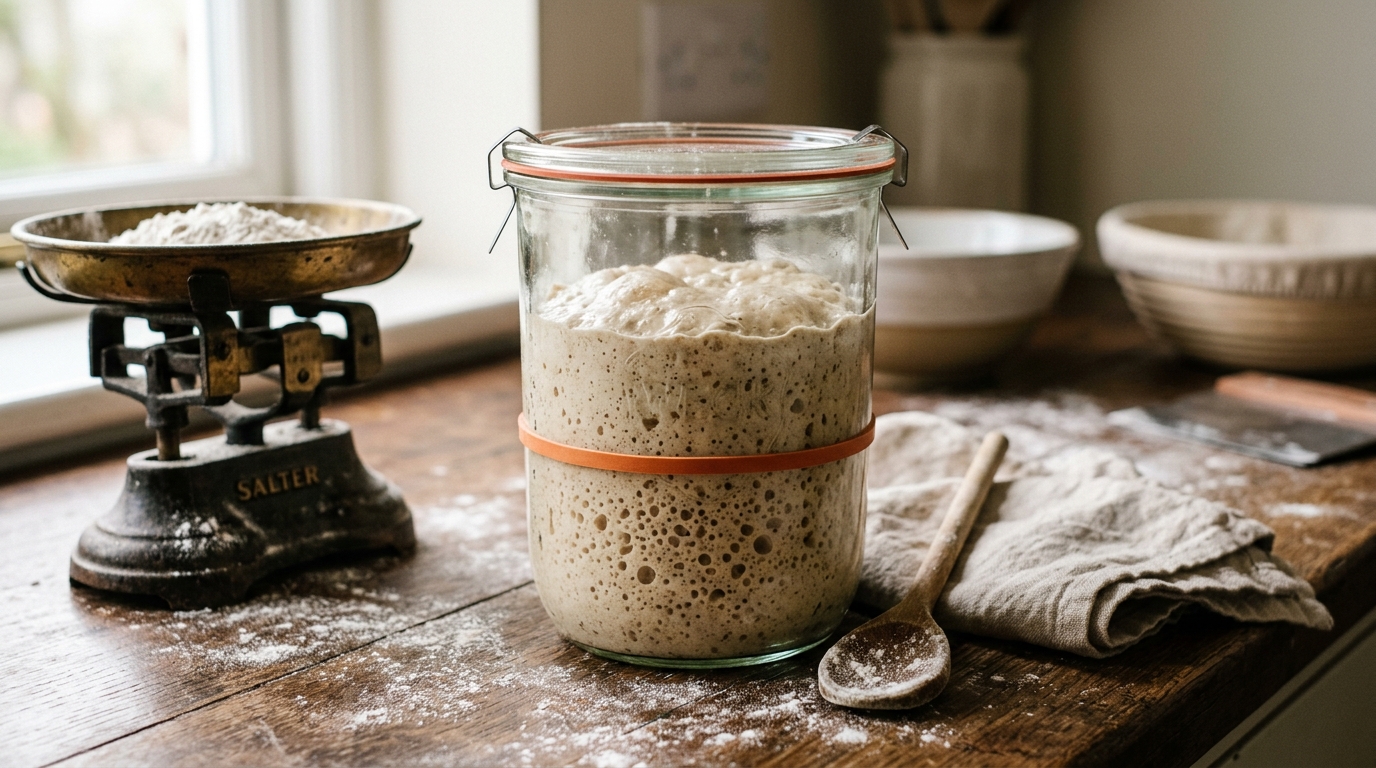
- Domed Top with Curved Edges: As fermentation gas inflates the gluten web, the dough bulges upward in the center with rounded, convex edges where it meets the container walls. Flat or concave edges indicate under-fermentation.
- Aerated Surface Blisters: Translucent micro-bubbles should be visible just beneath the skin of the dough.
- Aerated Jiggly Bounce: When you gently shake the container, the dough wobbles like a bowl of set gelatin. Dense, unfermented dough thuds heavily.
- Clean Separation: A wet fingertip inserted into the dough releases smoothly with minimal sticky residue.
4. The Aliquot Jar Technique for Perfect Measurement
Tapered mixing bowls make judging volumetric rise nearly impossible. To solve this, use an aliquot sample jar:
Immediately after mixing your dough, pinch off a small 40g sample and place it in a straight-sided small glass jar (like a spice jar). Mark the starting height with a rubber band. Because the sample experiences the exact same ambient temperature as the main batch, you can read the precise percentage rise (30%, 50%, 75%) without disturbing the main dough.
5. Visual Diagnostic: Under vs Perfect vs Over
Diagnosing past bakes helps calibrate future bulk timings:
- Under-Fermented: Loaf has a pale, tight bottom with a few giant cavernous holes ("fool's crumb") surrounded by dense, gummy dough. Dough felt sticky and lacked air bubbles during shaping.
- Perfect Bulk Fermentation: Tall, rounded loaf with a proud ear and evenly distributed, open honeycomb alveoli throughout the entire cross-section.
- Over-Fermented: Loaf collapses flat in the oven, crust is dull and pale with little caramelization, crumb is uniform and gummy with broken gluten walls, and bread tastes intensely acidic/vinegary.
Dial In Repeatable Bulk Fermentation Every Single Time
Never ruin a batch again with faulty timers. Get the Sourdough Fix-It Kit with temperature vs. rise curves, diagnostic crumb flowcharts, and printable batch journals.
Get The Sourdough Fix-It Kit ($7) →Frequently Asked Questions
Does the autolyse phase count toward bulk fermentation time?
No. Bulk fermentation begins the exact moment mature levain is incorporated into the flour and water mixture.
Can I do bulk fermentation entirely in the refrigerator?
Wild yeasts become largely dormant below 4°C (39°F). While bacteria still produce acetic acid, rise will take 48+ hours and often results in sluggish oven spring. We recommend completing at least 70% of fermentation at room temperature before cold retarding.
What should I do if my kitchen is very cold (under 19°C / 66°F)?
Use warm mixing water (28°C–30°C / 82°F–86°F), place your dough in an turned-off oven with the interior light on, or use a seedling heating mat to maintain 24°C (75°F).