
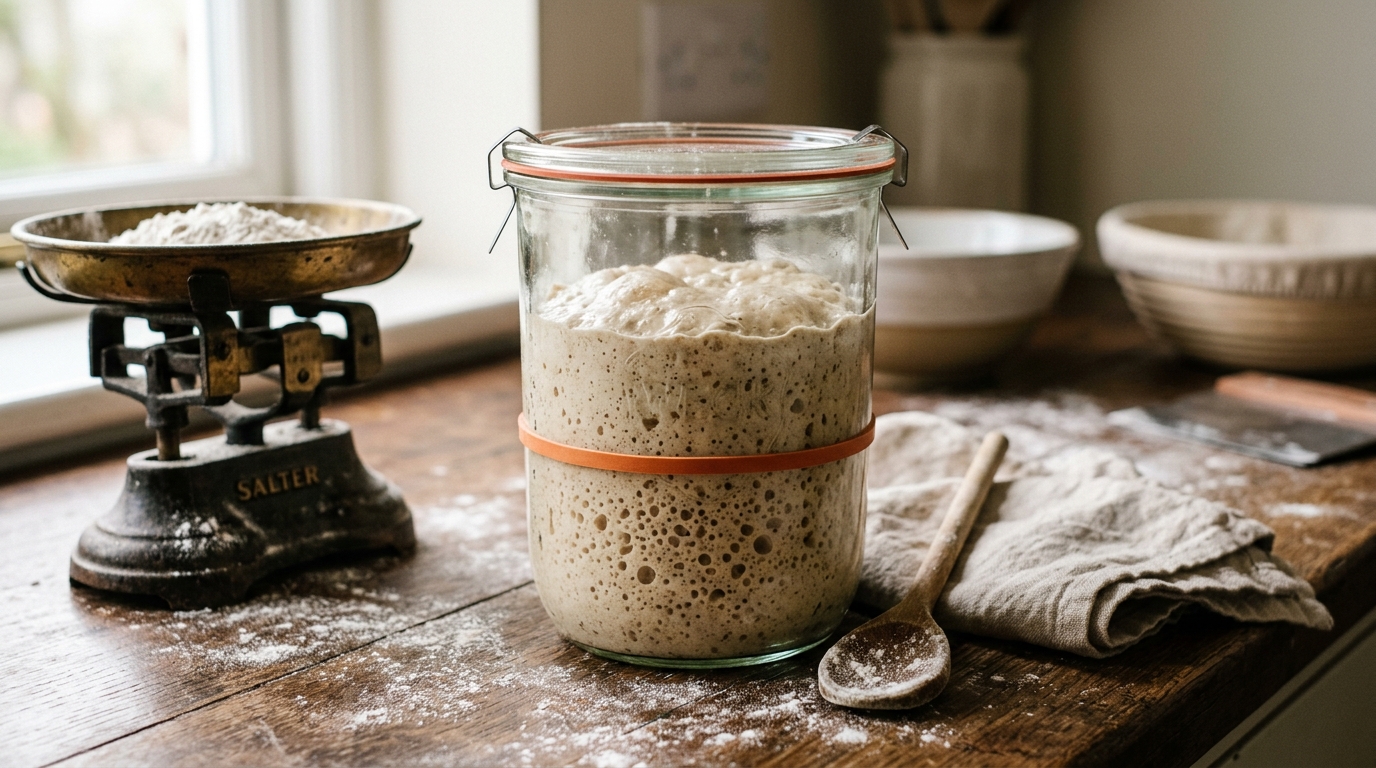
1. Why Refrigeration Protects Wild Yeast
Wild yeast (principally Candida humilis and Kazachstania exigua) and lactic acid bacteria become dormant at temperatures below 4°C (39°F). In this chilled environment, metabolic activity slows down by over 90%, allowing your culture to survive for weeks without consuming all its food source.
Refrigerating your starter eliminates the stress of daily counter feedings, saving hundreds of pounds of flour each year.
2. Preparing Your Starter Before Chilling
The biggest mistake bakers make is throwing an exhausted, collapsed starter straight into the fridge. To ensure healthy hibernation:
- Discard down to 20g of mature starter.
- Feed with a higher ratio: 1:3:3 or 1:4:4 (e.g., 20g starter + 60g flour + 60g water) using a 50/50 blend of whole rye and bread flour.
- Let it sit at room temperature for 1 to 2 hours until you see modest bubbling (about 25% rise).
- Seal the lid loosely (or fingertip-tight) and place it on a middle refrigerator shelf away from freezing cold spots.
3. What Is Hooch and Should You Pour It Off?
Hooch is the clear to dark brownish liquid that accumulates on the surface of neglected sourdough starter. It is an alcohol byproduct indicating your starter has metabolized all available sugars and is hungry.
Should you pour it off or stir it in? If the liquid is clear or pale amber, stir it back in for a tangier flavor profile. If it is dark grey or black with an astringent, vinegary odor, pour it off carefully and rinse the top layer before feeding.
4. The 2-Step Revival Protocol for Bake Day
Do not bake with cold starter straight from the fridge. Follow this two-step revival timeline:
- Step 1 (24 hours before bake): Remove jar from the fridge, discard down to 25g, and feed 1:2:2 with warm water (26°C / 80°F). Allow to peak at room temperature.
- Step 2 (Bake day morning or night before): Feed 1:4:4 or 1:5:5 to build your active levain. When it reaches peak rise (doubled or tripled), it is ready to inoculate your dough.
5. Hibernation for Months or Years
If you are traveling for months, you have two proven preservation options:
- Dehydration: Spread active starter thinly on parchment paper and let it air-dry completely. Crumble into flakes and store in a sealed jar at room temperature for up to 5 years.
- Freezing: Feed your starter, let it rise by 50%, and freeze in airtight silicone portions for up to 6 months.
Track Every Feeding & Doubling Window
Keep a clean record of your fridge cycles, revival times, and feeding ratios with the complete Starter-to-Loaf pack: includes the Maintenance Manual and printable counter journals.
Get Starter to Loaf Master Pack ($17) →Frequently Asked Questions
How long can a sourdough starter survive in the fridge without feeding?
A healthy, mature starter can comfortably survive 3 to 4 weeks in the fridge without attention. With a high-ratio feeding before chilling, some starters survive up to 2 months.
Does the dark liquid on top mean my starter is dead?
No! That dark liquid is hooch (alcohol). It simply means your starter is hungry and needs fresh flour and water. As long as there is no orange, pink, or fuzzy mold, your starter is completely safe.
Can I bake directly with chilled starter?
It is not recommended. Chilled starter has sluggish yeast and high acidity, which weakens gluten and leads to a flat, dense loaf. Always give it at least one room-temperature feeding before mixing dough.