
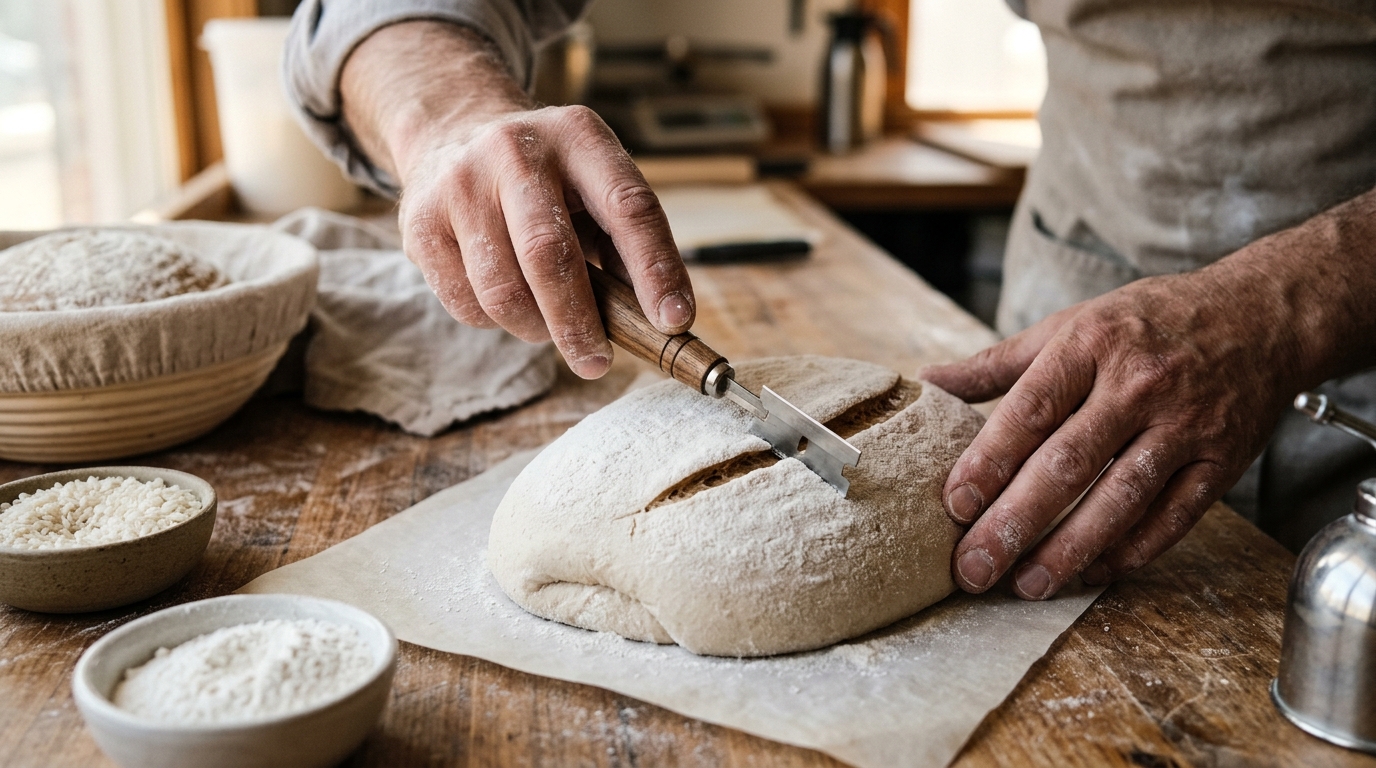
1. The Physics of the Sourdough Ear
An artisan sourdough "ear" (or grigne in French) is not an accident of luck — it is the direct physical result of directional steam expansion meeting an angled cut on a well-tensioned dough skin.
When high heat hits the dough in the first 10 minutes of baking, gas rapidly expands (oven spring). If you cut an angled flap of dough, the lower portion peels back while the top flap lifts upward and curls, creating that jagged, crunchy crest every artisan baker covets.
2. Cold Retard: Clean Cuts Without Drag
Attempting to score warm, room-temperature dough almost always leads to blade drag, torn gluten, and a collapsed cut. Warm dough is soft and behaves like a sponge.
The secret: Always proof your loaf overnight in the refrigerator (3°C–4°C / 37°F–39°F). Cold dough firms up significantly as starches and fats solidify, forming a taut surface that can be sliced cleanly like chilled butter with zero resistance.
3. Blade Angle: 30-Degree Incline vs Vertical Cut
The single most common scoring mistake is holding the baker's lame perpendicular (90 degrees) to the loaf. A 90-degree cut causes the dough to split evenly in both directions, producing a wide chasm without an ear.
To produce a proud ear, hold the curved razor blade at a 30-degree to 45-degree angle relative to the dough surface. You are intentionally creating a small "overhang" or flap of dough. As steam forces the loaf upward, this upper flap curls upward while the base expands downward.
4. Scoring Depth and Decisive Blade Movement
Score decisively in one smooth, confident stroke from one pole of the loaf to the other. Hesitation creates jagged edges.
Aim for a depth of approximately 6mm to 10mm (1/4 to 1/2 inch). Cutting too shallow (1–2mm) results in premature crust sealing, while cutting too deep (over 15mm) causes structural deflation.
5. The Crucial Role of Trapped Steam
Even with flawless blade technique, your ear will fail without sufficient humidity in the first 20 minutes of baking. In a dry oven, the outer starches dry and harden within 3 minutes, cementing the cut closed before maximum oven spring can occur.
Baking inside a preheated, tightly lidded Dutch oven traps the moisture evaporating directly from the dough, keeping the crust gelatinized and pliable so the ear can peel open to its maximum height.
Master All Blade Angles & Clean Ear Expansion
Discover full-color scoring diagrams, 30-degree blade trajectories, and diagnostic crumb flowcharts in the Sourdough Fix-It Kit.
Get The Sourdough Fix-It Kit ($7) →Frequently Asked Questions
Why does my razor blade drag and stick to the dough?
Blade drag is caused by warm dough or dry blades. Ensure your dough is cold straight from the fridge, and dip your razor blade in cold water or cooking oil right before making the cut.
Should I use a straight or curved lame for scoring an ear?
A curved lame is specifically designed for creating ears because the curvature naturally slides underneath the dough at a 30-degree angle, forming the overhang flap effortlessly.
Can I get an ear on a round boule, or only on an oval batard?
While an oval batard produces the most dramatic crescent ear, you can easily create an ear on a round boule by making a single curved slash along one side of the perimeter.